
Israeli Tech Radar 2026-27: The Survey Results
730 engineers, tech leads, architects, and decision-makers shaped this year's radar. Here's what the data told us about how Israeli engineering teams actually build software today.
Who Shaped This Year's Radar?
730 engineers, tech leads, architects, and decision-makers participated in this year's survey — the final validation layer for the Radar. They classified technologies as actively in Production, undergoing PoC, or planned for End of Life.
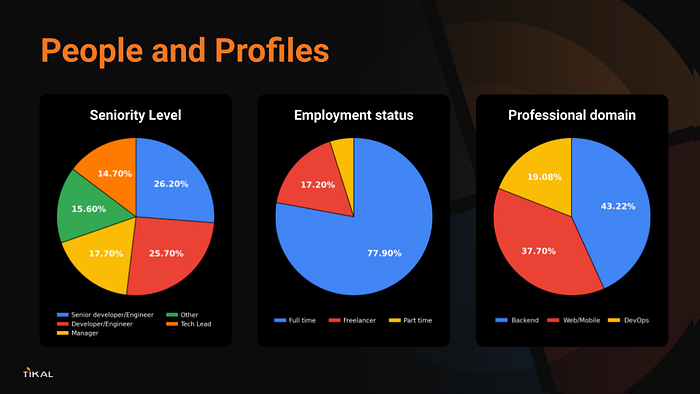
The profile of respondents matters. Over 40% are senior engineers or tech leads, with an additional 18% in engineering leadership. These are the people making real architectural decisions every day — not watching demos at conferences.
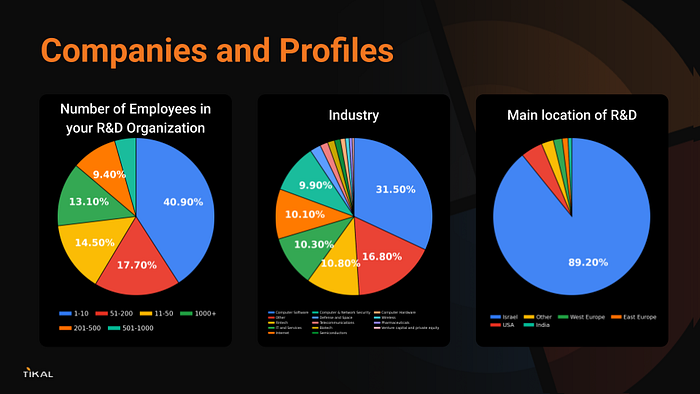
Nearly 90% of R&D centers represented are based in Israel, making this the most accurate mirror of our local industry that exists. About 41% come from teams of 1–10 engineers: fast-moving, willing to experiment, and quick to adopt when something genuinely works.
AI/ML: The Market Has Made Its Choice
We asked a direct question: what is your primary AI coding tool? The answer was unambiguous. Claude Code has captured over 53% of the market. GitHub Copilot — the dominant tool just two years ago — has dropped below 12%. Cursor holds second place at 17%.
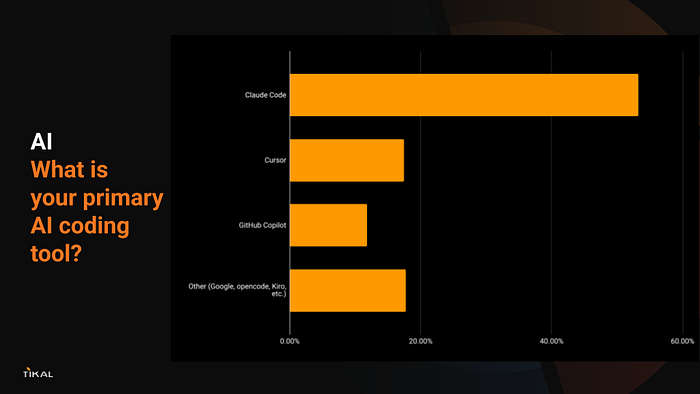
This isn't a tool preference. It's a signal about how developers want to work. They've moved past autocomplete. They want agents that can run multi-step tasks — and they've found something that delivers.
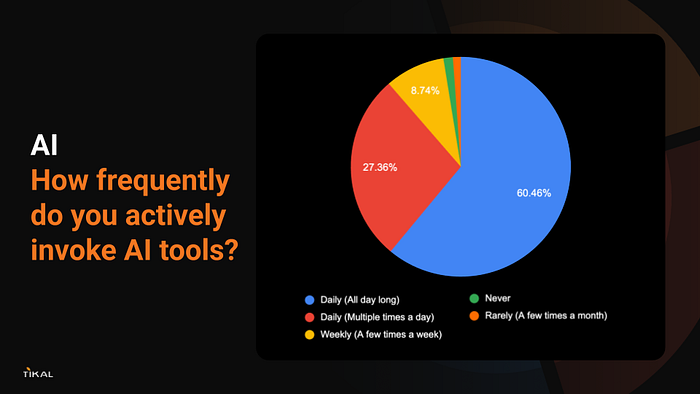
88% of engineers use AI tools daily. Over 60% use them all day long. AI is no longer a tab you open when you're stuck. It runs alongside everything, continuously.
On rework: 32% report AI-generated code rarely needs significant rework. 55% say occasionally — that middle group is where the risk lives. On code review: about 50% are seeing PRs close faster, but 26% say review is now slower, because agents produce massive, complex code blocks in seconds that take far longer for a human to verify.
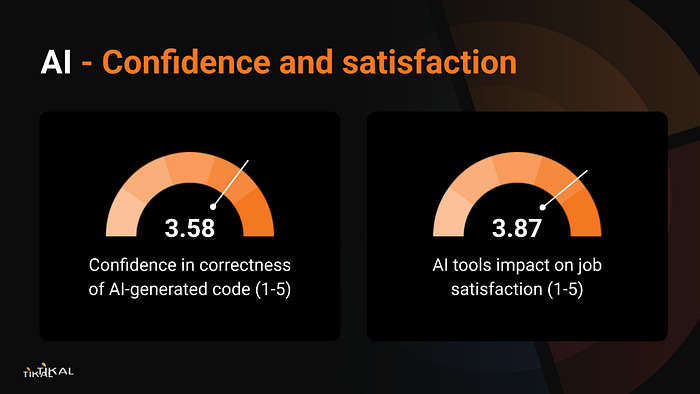
Job satisfaction with AI tools scores 3.87/5. Confidence in the correctness of AI-generated code is 3.58/5. The gap between “I love how fast I can work” and “I'm not sure I can trust what I just shipped” is the defining tension of this moment in software engineering.
Backend: Data and AI Have Taken Over
Kafka holds at nearly 45% — the undisputed standard for event-driven architectures. But the story of Backend in 2026 is what surrounds it: LLMs, RAG, and VectorDBs. Modern backend engineering is fundamentally about moving large volumes of data to feed models.
DevOps: Stable Foundation, New Priorities
The stack is mature. The movement is in how teams use these tools — DevOps is shifting from service provider to platform builder.
Frontend: TypeScript All the Way Down
One language, all the way across the stack. Frontend architecture has grown up — these are complex distributed systems, not simple UIs.